

Goals
LUMIRing is a live test bed fostering the development and innovation of multicore fibre technology.
Summary
The LUMIRing project aims to deploy a multi-core fiber (MCF) test bed within Lisbon Metro’s Yellow Line — an ambitious and groundbreaking initiative to explore weakly coupled MCF transmission under real-world conditions. By leveraging the harsh mechanical stresses caused by metro operations in underground tunnels, the project offers a unique opportunity to investigate and address real-life transmission challenges.
A core goal is to design, implement, and validate advanced techniques that both mitigate performance degradation and enable the integration of data transmission with sensing, pushing the limits of current MCF capabilities.
The test bed’s main infrastructure includes a 12-tube cable, with each tube containing 12 fibers. The cable contains 74 standard cladding diameter WC-MCFs (of 5 different types, with 4 and 7 cores and with step and trench-assisted refractive index profiles) and 70 conventional single-mode single-core fibers (SSMF).
The cable will run for around 26 kilometers, linking the Optical Communications Laboratory at Iscte (LCO Iscte) to the Yellow Line of the Lisbon Metro, passing through the Rato and Odivelas stations, returning to the LCO Iscte. The LUMIRing test bed dramatically extends the maximum range of other available test beds, allowing up to 728 km of 4-core WC-MCF, underscoring its exceptional suitability for long-haul transmission testing under real-world conditions.
Objectives
This innovative cable deployment and test bed will serve as a critical enabler for advancing MCF research and technology, unlocking a range of high-impact opportunities.
Facilities
Optical Communications and Photonics Group (OCPG) of IT-IUL
The Optical Communications and Photonics Group (OCPG) of IT-IUL focuses on optical communication systems and networks with the goal of expanding the data capacity transmission limits in fiber optics. The OCPG studies and characterizes physical layer issues regarding optical fiber transmission, explores new components and system solutions, and develops and improves optical networking planning tools aware of physical layer characteristics. The final aim is to test and ensure enhanced Quality-of-Transmission (QoT) and a high-capacity throughput in optical communication systems and networks.
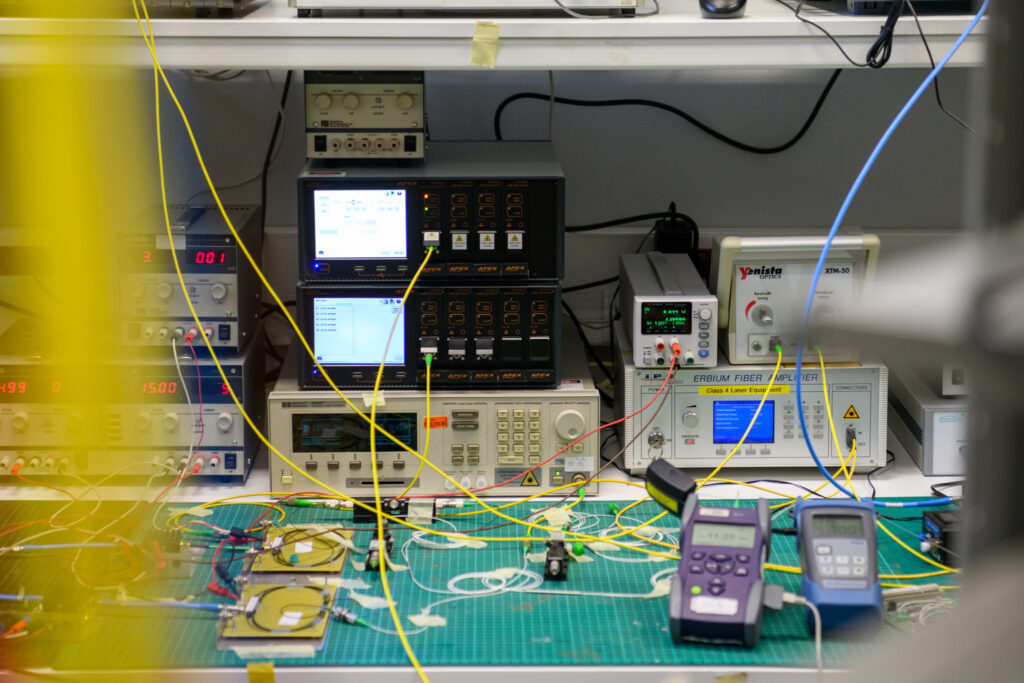
The laboratory of the OCPG of IT-IUL (LCO Iscte) is equipped with a 4-core, a 7-core and a 19-core MCFs indicated for high-capacity experimental demonstrations. Signal generation and acquisition is performed by using arbitrary waveform generators and real-time oscilloscopes with maximum bandwidth of 40 GHz and sampling frequency of 256 Gsamples/s.
The lab is equipped with electro-optical and opto-electric converters with 40 GHz of bandwidth and several optical devices as amplifiers, wide and narrow bandwidth filters, circulators, splitters, optical switches, polarization beam splitters/combiners, etc., indicated to implement experimental demonstrators in optical fiber communication systems. A temperature controlled chambre is also available in the lab.
The OCPG has currently (from 2025-2028) the coordination of a MSCA Doctoral Network “Multicore fiber applications and technologies (MATCH)”, with total budget 3.4 M€, that involves 14 partners and grants support to 13 Doctoral Programs (PhDs).
The OCPG has permanently open positions for PhD students and post-doc researchers.


LUMIRing Expands Experimental Capabilities for Real-World Multicore Fibre Transmission
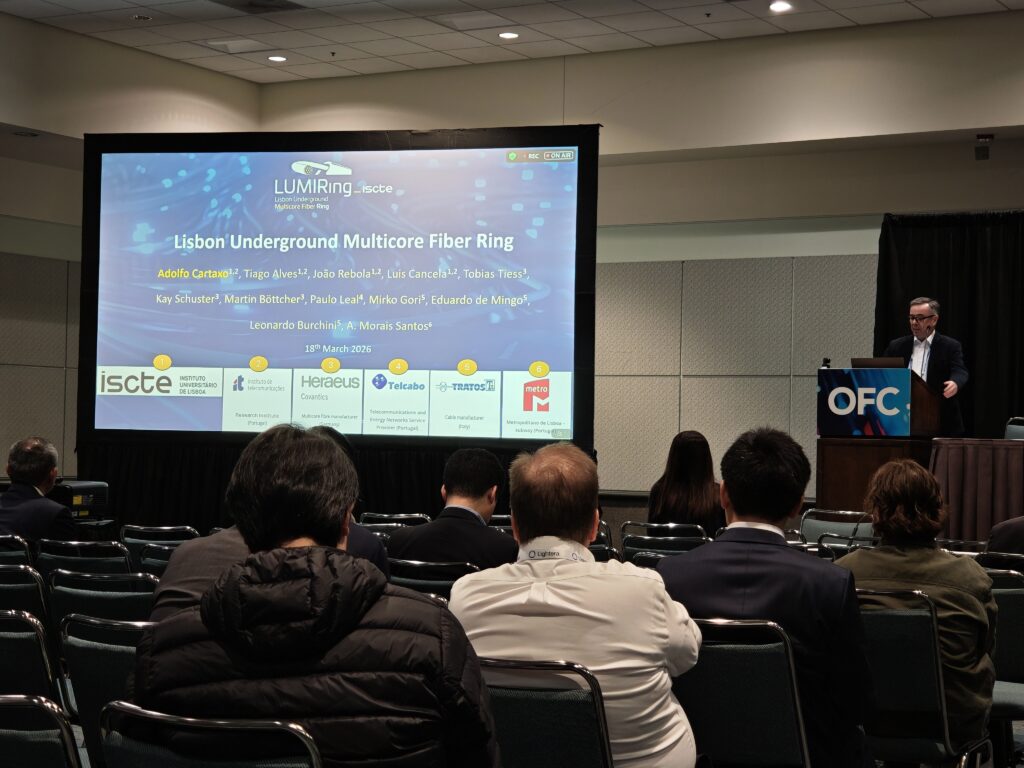
LUMIRing recognized at OFC 2026 as a global reference in multicore fiber technology
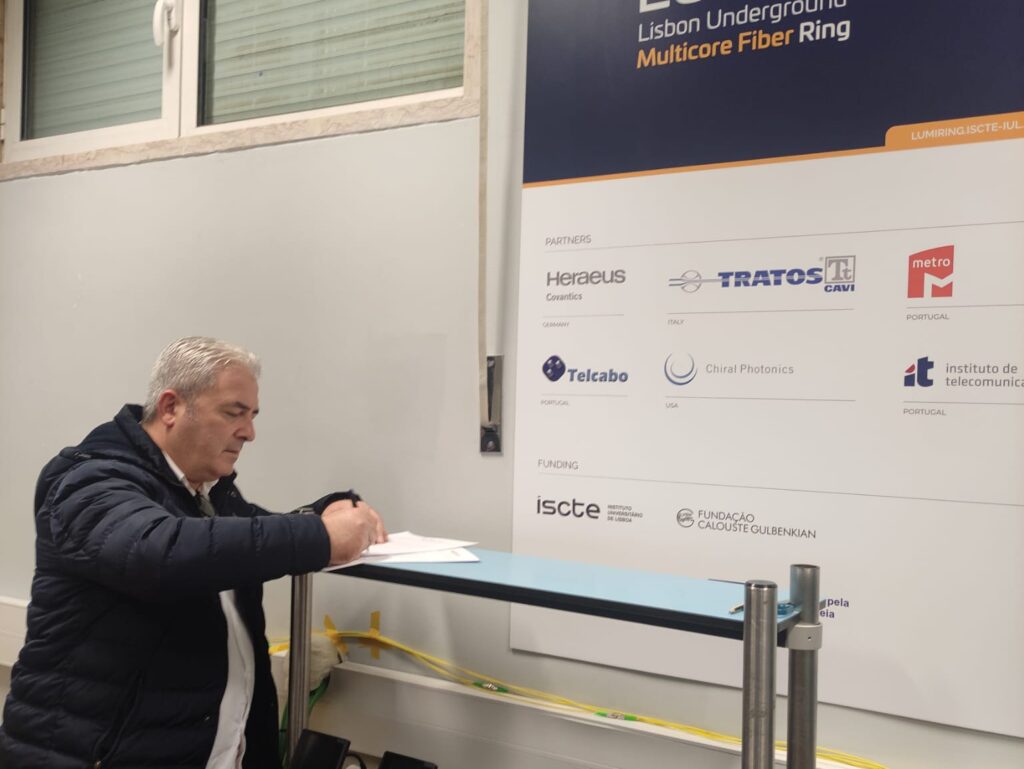
Multi-Core Fiber Optic Cable Installation Moves to Provisional Acceptance Stage

The ceremony of the Official Inauguration
Official Inauguration of the Multicore Fiber Optic Testbed to Take Place on November 3 at Iscte
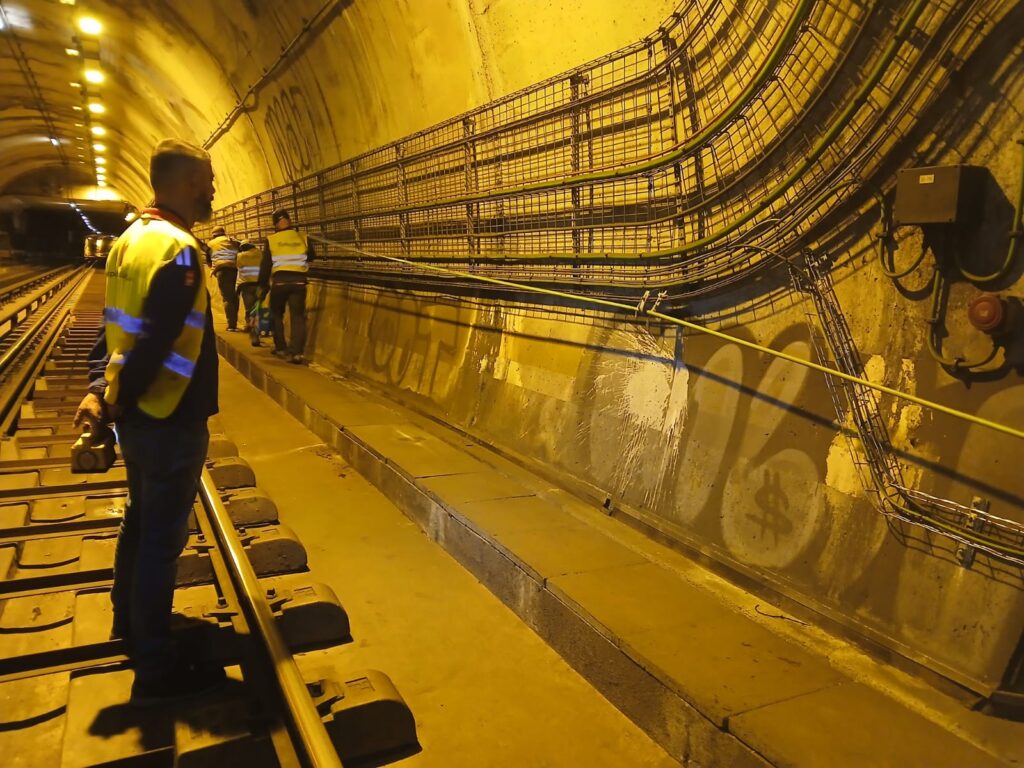
Fiber optic cable installation begins in Lisbon Metro

Iscte transforms Lisbon Metro into a living laboratory for urban innovation
November 4, 2025

Official Inauguration of the Multicore Fiber Optic Testbed
November 3, 2025

Japanese state agency NICT joins Iscte in fiber optic test bank
October 14, 2025
Iscte installs largest fiber optic test bench in Lisbon
September 19, 2025

RTP Notícias 🇵🇹 | October 14, 2025

Chiral Photonics 🇺🇸 | October 09, 2025

Heraeus Covantics 🇩🇪 | October 06, 2025
Funding


